Cork & Cycling
A sustainable city break in Cork
Cork is compact, walkable and well connected by rail and bus, which makes it an easy city to visit without a car. This is a local guide to planning a greener few days here, written by someone who runs bike tours around the city.
Why Cork works for a sustainable city break
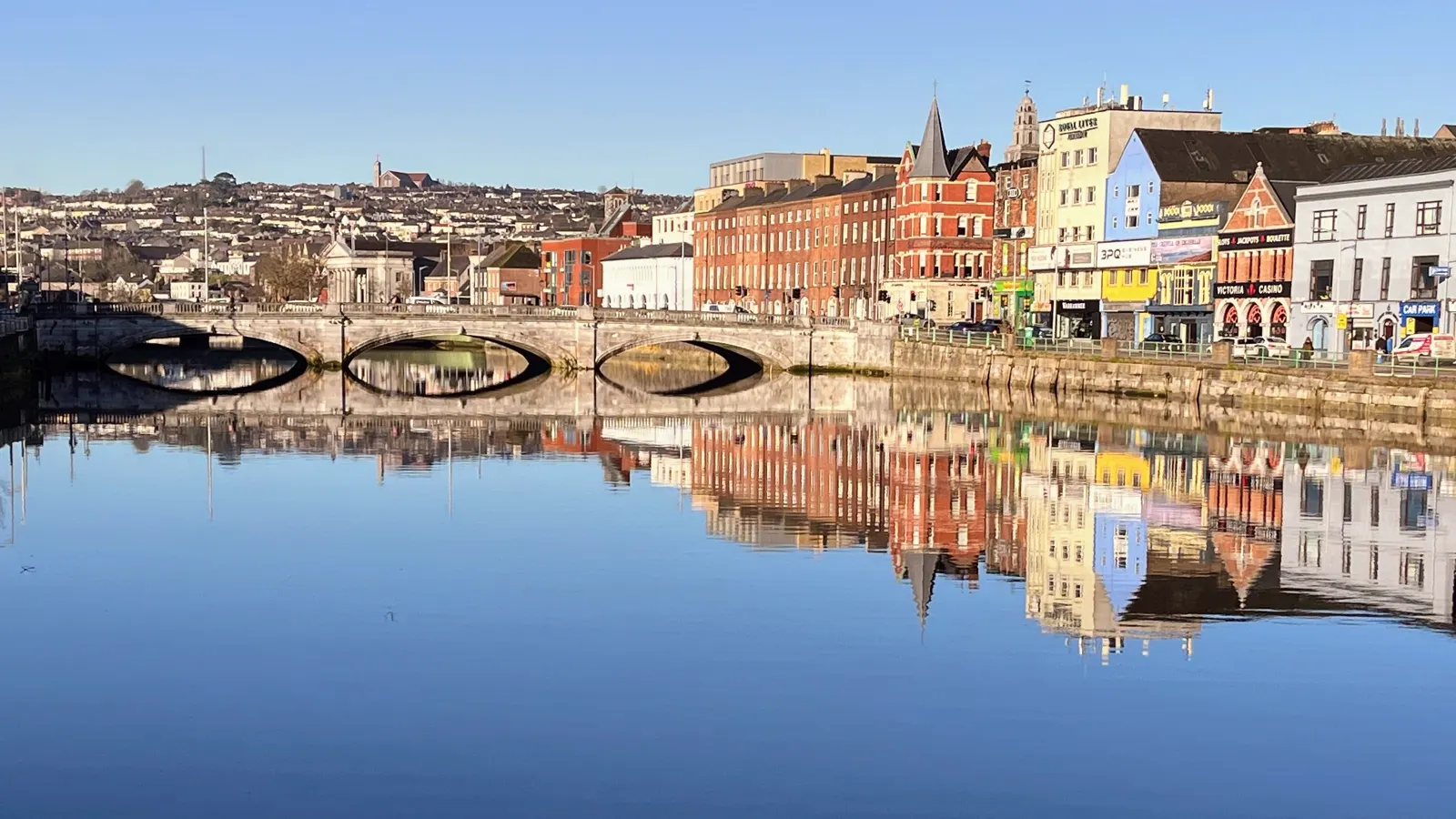
Cork sits in the south of Ireland and has a population of around 300,000. It is a lively city with colourful streets, good bars and a genuinely excellent food scene, along with plenty of parks and green space. Almost everything a visitor wants to see is within walking or cycling distance of the centre.
That compactness is the single biggest reason Cork suits low-carbon travel. Once you arrive, you rarely need a car. The city celebrates its history while trying to balance growth with sustainability, and the nearby harbour towns are reachable by train or bus.
Where to stay
Choosing somewhere in the city centre, or close to public transport, cuts out most of the driving a trip would otherwise involve. Visit Cork, the local tourism agency, publishes a list of accommodation that has achieved sustainability certification, which is a useful starting point when comparing hotels.
How Cork came to look the way it does
Cork is built where the River Lee flows into Cork Harbour, on what was once a cluster of marshy islands. The location was strategically important and brought prosperity through trade — and also periodic flooding. The river and the harbour still shape how the city develops.
The city dates back around 1,500 years to when St Fin Barre founded a settlement here. Vikings arrived next, then the Normans. By 1600 Cork was a walled city of roughly 2,000 people. A siege in 1690 destroyed much of the city and its walls, which led to its expansion as a canalled city. Those canals were gradually covered over, leaving the two river channels that frame the city centre today.
Two things that set Cork apart
A long culinary tradition
International trade shaped the city's food heritage. Cork has a brewing tradition going back centuries — Murphy's and Beamish are still brewed here, and craft brewers like the Franciscan Well continue the tradition. As a port city, Cork became a hub for exporting salted beef and pork, and local dishes such as tripe, drisheen and crubeens are a reminder of that resourcefulness.
The Cork Butter Exchange, established in 1770, made the city the world's largest butter exporter by the 19th century, and local producers still make award-winning cheese and dairy. Spices carried home on ships from the West Indies inspired spiced beef, a dish unique to Cork and still a Christmas tradition.
Cork Harbour
Cork Harbour is one of the world's largest natural harbours. It supports everything from fishing and farming to shipping and tourism, and it is lined with villages, lighthouses, castles and old military forts such as Camden and Davis. Spike Island, once a prison, is now open to visitors, and Fota Wildlife Park and Charles Fort in Kinsale are both easy family outings.
Three outdoor things to do
See the city by bike
Cork is small enough to explore properly on two wheels. A guided ride takes in colourful streets, quiet parks and riverside paths, and passes landmarks like Shandon, St Fin Barre's Cathedral and University College Cork. The route through the centre is flat and suits all experience levels.
- Starts in the heart of the city, close to hotels and the train and bus stations.
- Pedal power leaves no carbon behind, and e-bikes are available for anyone who wants a hand on the pedals.
- The flat route makes it accessible to a wide range of fitness levels.
- Guides point out the city's wildlife, murals and street art along the way.
Walk the Docklands and the Marina
The Docklands were once an industrial hub and are now a link between the city centre, the Marina Promenade and Blackrock. The Marina Market is a covered space of food stalls and local makers. From there the riverside promenade passes Páirc Uí Chaoimh and the rowing clubs and winds on towards Blackrock village and Blackrock Castle Observatory, a 16th-century fort that now houses a science centre.
Continuing east, the Cork Harbour Greenway offers around 20km of flat, traffic-free cycling with harbour views for most of its length.
Visit UCC and Fitzgerald's Park
University College Cork, founded in 1845, is consistently ranked among the world's greenest universities. Its grounds mix historic architecture with meadows, redwoods and cedars. Look for the Honan Chapel and its Harry Clarke stained glass, the Stone Corridor with Ireland's largest collection of Ogham stones, and the Glucksman Gallery.
A short walk away, Fitzgerald's Park is more than 120 years old and holds the Cork Public Museum, a riverside café and the Sky Garden. Daly's Bridge — the Shakey Bridge — is worth crossing at least once.
Day trips without a car
- Kinsale, about 25km away: colourful streets, seafood and Charles Fort, reachable by bus.
- Crosshaven: a quiet coastal village with Camden Fort Meagher and harbour views.
- Cobh: the Titanic's final port, St Colman's Cathedral and the ferry to Spike Island, with frequent trains from Cork.
- Midleton: the Jameson Distillery and a Saturday farmers' market, a short train ride from the city.
Where to eat
Cork's coastal waters and farmland supply a remarkable amount of what ends up on the plate, and a large share of Ireland's artisan food producers are based in the county. The English Market, open since 1788, is the heart of it — butchers, bakers, fishmongers, cheesemongers and olive sellers under one roof.
On Saturdays, Cornmarket Street hosts a farmers' market, continuing a tradition that goes back to the old Irish Market once held there. There are further farmers' markets in Douglas and at Mahon Point. Small-scale producers here tend to use low-impact methods by necessity, and larger farms are increasingly adopting better land management and reduced fertiliser use.
Where Cork is heading
Cork has largely avoided over-tourism, and green space is treated as something to protect rather than build on. The regeneration of the Docklands and the investment in McCurtain Street show what is possible when public space is taken seriously. Proposals to link the Cork Harbour Greenway with a route to the Lee Fields would create a continuous corridor from Ballincollig to Crosshaven.
There is still work to do — more public transport, better reuse of old buildings, and improved flood and water management. But for a visitor who wants a city break with a light footprint, Cork already makes it easy.